
Syringe filters for research use only and medical devices
Over 120 different syringe filter product codes provide one of the widest choices to optimally meet your application requirements, from medical device sterile filtration to research use cell culture purposes.
Manufactured under high ISO standards in full automation to ensure high-quality and reliable performance. Engineered to offer some of the best membrane-to-plastic housing ratios for fast, efficient filtration, while minimizing environmental impacts.
Shop Minisart® syringe filters by type


New products & promotions

Video: How to Perform a Visual Bubble Point Test
The bubble point is a reliable, indirect indicator of membrane integrity. Follow the methods in this video to test your Minisart® syringe filters with a hand-held bubble point measurement.
Explore the Minisart® syringe filter family
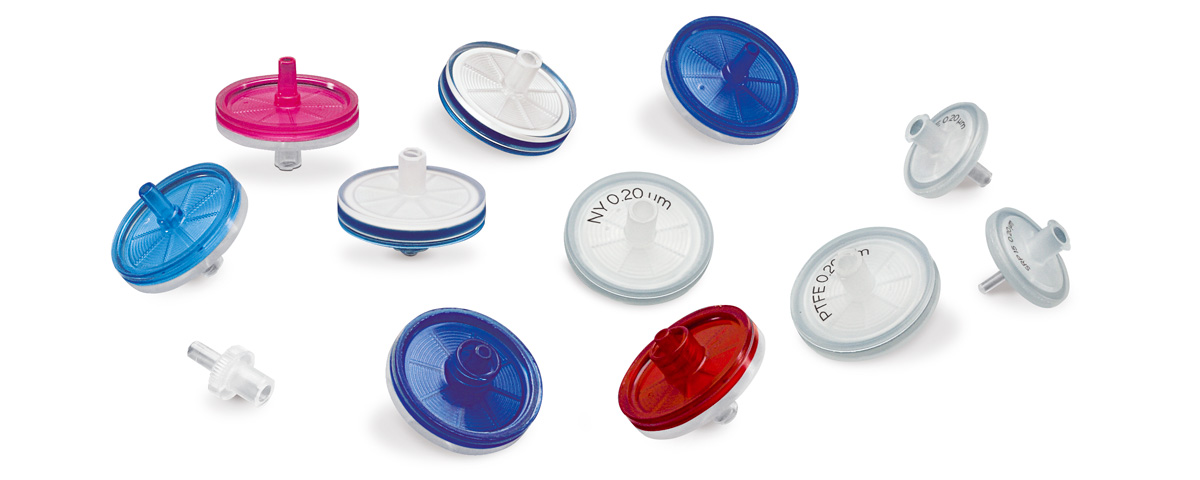

Minisart® PP Syringe Filters
Sample preparation for analytics
Minisart® PP Syringe Filters offer essential elimination of particles from the sample prior to HPLC | UHPLC | ICP-MS or other chromatographic analysis, in addition to chemically robust polypropylene housing with inert, PTFE, RC, or Nylon membrane options.
- Wide range of filter areas; 0.07 cm2, 1.7 cm2 and 4.8 cm2
- Maximum chemical resistance
- Low extractables

Minisart® NML Syringe Filters
Sterile filtration, clarification, and particle removal
Minisart® NML Syringe Filters provide the optimal method for clarification and sterilization of liquids, robustly removing bacteria and particles, without any impact on product quality or loss of target molecule.
- Superior filter areas up to 6.2 cm2
- 0.1µm to 5µm pore sizes
- Low adsorption characteristics

CE-Minisart® Syringe Filters
The Sartorius medical device CE-Minisart® syringe filters product families with hydrophilic (surfactant-free) cellulose acetate and/or hydrophobic polytetrafluoroethylene (PTFE) membrane with different pore sizes are the perfect choice for particle removal, clarification or sterile filtration of low volumes of aqueous solutions, or air and gases.
They are suitable for use as accessories to syringes | injection systems | aspiration | venting systems with Luer connectors in professional healthcare settings.
For detailed information regarding the Intended Purposes of the three different product families, please refer to the IFU available at Minisart® User Manual
- CE-certified and registered in various countries.
- Easy to use.
- Low adsorption.
- Manufactured according to an ISO 13485-certified QMS and (EU) 2017/745 (MDR).
- Biocompatible according to ISO 10993-1.
- Available as non-sterile or sterile (ethylene oxide (EO) or gamma-irradiated).

Frequently Asked Questions
Syringe filters are single-use filtration devices that are made up of a membrane, or combination of membranes, placed inside molded housing. The connections on the device are commonly Luer lock or Luer slip and enable a quick connection to syringes, that are used to pass the liquid sample through the filter.
There are multiple membrane types, pore sizes, and housing material variants.
Primary uses of syringe filters are the general clarification of particles from a liquid or air/gas samples, the sterile filtration of a sample to remove bacteria, the removal of particles and suspended solids prior to analytics such as HPLC. Syringe filters may also be used for gas venting, allowing clean, sterile air to pass through in vessels such as bioreactors.
Syringe filters are chosen based upon suitability to a user's application. Syringe filters are typically split in five categories, based upon the user applications:
- Analytical sample preparation filters
- General clarification and sterile filtration filters
- CE mark Medical Device filters
- Specialty filters, such as those with activated carbon and
- Venting filters for air and gases
Please refer to our helpful Minisart® Syringe Filter Selection Guide to better understand how to choose the right syringe filter for your application.
Syringe filters are typically single-use and should not be reused as syringe filter performance is based upon the first filtration. Reuse may negatively impact performance and sample results, due to causing cross-contamination, loss of sample, or blockage due to membrane fouling. However, reusable syringe filter holders are available that utilize replaceable membranes.
There are several methods of sterilization, such as gamma irradiation, e-beam, ethylene oxide gas exposure, and autoclaving. It is recommended to use devices pre-sterilized by the manufacturer if sterilization is required, to ensure performance and certified sterilization. Alternatively, some devices may be autoclaved in the lab, but this should be checked for each device.

Guides, Webinars, and More


Sartorius Syringe Filters Offer:

Chemically resistance syringe filters for analytical sample prep, low binding membrane materials for biologics and both Gamma Irradiation and Ethylene Oxide sterilized device options.
Highest membrane surface areas in larger devices for fast & easy filtration of large volumes, with reduced membrane areas in smaller devices for minimum hold up of precious samples.
Automated manufacturing and in-process controls for both research use and medical device Minisart® device options.
