Lab Equipment, Integrated Weighing Solutions to Support Battery Manufacturing
Material refiners, battery manufacturers, OEMs and recyclers are all invested in meeting global carbon neutrality goals and developing the super battery. Developing safe, durable rechargeable batteries that satisfy “green” mobility initiatives requires significant investment in research and development (R&D) and quality control (QC), as well as expertise in production stages.
Sartorius provides solutions for several steps of the rechargeable battery manufacturing process - from material purity determination and in-process optimization to final release - with intuitive lab tools and integrated weighing solutions, further enhanced by multivariate data analytics.


Explore the Process Steps for Battery Manufacturing
Rechargeable Batteries Life Cycle
Discover the different steps in the battery workflow and all applications Sartorius offers for your battery process. Click on the icon „+“ to learn more. Explore all applications for Battery Manufacturing below the workflow.
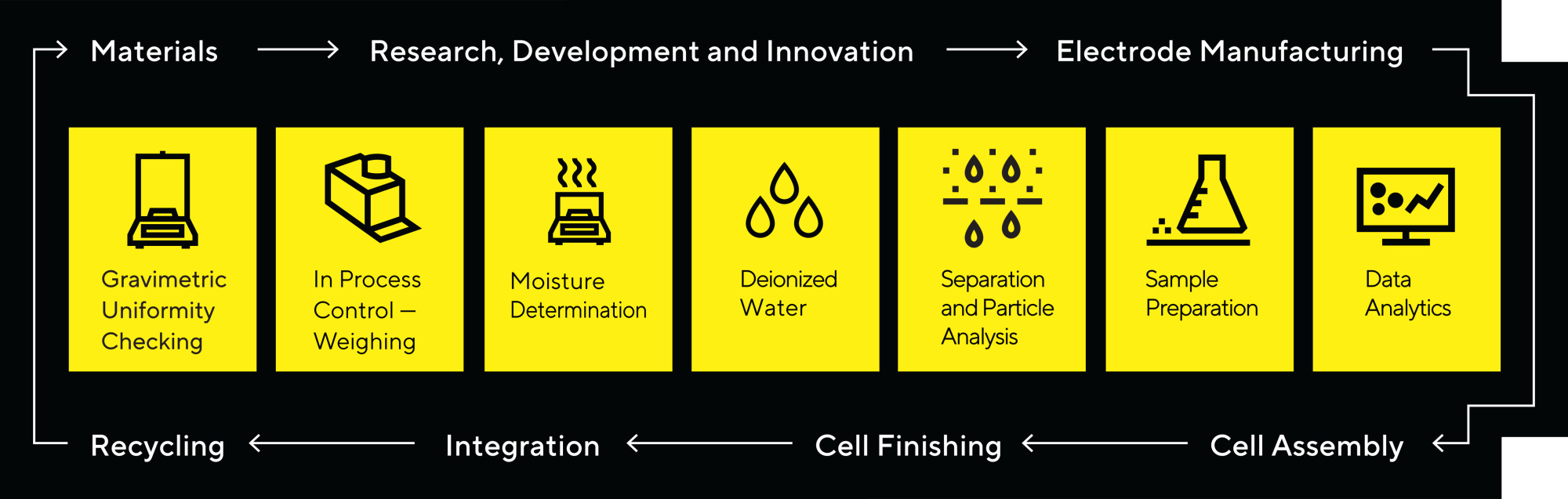
Applications for Battery Manufacturing







Sartorius Battery Manufacturing Solutions Offer:


State-of-the-art lab equipment and consumables to help drive innovation
Reduce variation and scrap by using high-resolution weigh cells or rapid moisture determination
Optimize your processes and elevate battery performance using multivariate data analytics
Products to Support Rechargeable Battery Manufacturing and Recycling
Featured Products

Cubis® III
The new Cubis® III balances have built-in compliance and connect directly to any digital ecosystem (LIMS/ELN/MES), vastly simplifying processes. This significantly lowers total cost of ownership per unit, today and over the long term, across integration, validation, updates, and automation—while keeping extra middleware out of the data workflow.
Two models, Cubis® III and Cubis® III Max, to meet different levels of connectivity, data integrity and compliance requirements.

MA160 Moisture Analyzer
Understanding and maintaining the correct moisture content of a product is essential during manufacturing, as well as in research and development and testing laboratories. In a quality control environment, standard moisture testing approaches can be time-consuming, causing delays in production and in facilities that process a number of different kinds of samples, it can be challenging. By using a moisture analyzer you can overcome these bottlenecks and achieve results comparable to your standard method in minimal time.
The MA160 moisture analyzer is designed for quick and reliable moisture testing of a variety of samples, including liquids, pastes, and solids. It accommodates changing requirements by enabling you to use specific methods and efficiently manage all parameters.
Additional features include:
- Enhanced repeatability and balance
- A durable design that withstands heat and harsh environments
- Optimal weighing mechanism (no battery necessary

Simplify Lab Water Use
Ideal lab water systems streamline processes by giving users full control of quality parameters at the point of use. The innovative and flexible Arium® Smart Station addresses these requirements by letting you dispense ultrapure water in the exact quality and quantities required for your experiments - when and where you need it.
Frequently Asked Questions
Battery production is subject to many constraints:
- Ecological - Carbon neutrality objective
- Economic - Reaching parity price for EV manufacturers
- Political - No geopolitical dependence
- Transport - Safety or disruption of the supply chain
- Technological - New chemistries and increased energy density
These challenges can be overcome by building successful local partnerships across the supply chain, from active materials to manufacturing, vehicle assembly and recycling.
In simple terms, lithium-ion rechargeable batteries are made of two electrodes, a separator and filled with electrolyte. The technology is constantly evolving to increase safety and evergreen energy density.
- Cathode: A mixture of active materials such as lithium metal oxides (NMC, LFP, LMO, LCO), conductive additives and binders (SBR, PVDF) coated precisely on an aluminum collector
- Anode: The materials commonly used are based on carbon (graphite), lithium alloyed metals and binders coated in a thin layer on a copper collector
- Electrolyte: It combines polymer or water-based solvents and lithium salts
- Separator: Typically, multilayer sheets made of PE or PP polyolefins, offering a compromise between excellent mechanical strength and sufficient porosity to facilitate ionic exchanges in the cell
Lithium reacts with moisture in the air to create lithium hydroxide and hydrogen. This not only reduces the capacity of the battery and number of cycles, but also affects the structural stability of positive and negative materials. For this reason, manufacturers work in controlled environments - like a dry room - to allow for strict monitoring of water content during the LIB manufacturing process.
Grammage is the weight of the electrochemically active material per unit area of the current collector. It is defined by the thickness of the electrode coating and is usually represented in mg/cm². The grammage influences capacity and cycling behavior.