Product Characterization Services
Ensure successful approval of biologics with comprehensive protein characterization and biosafety testing services
Successful approval of biologics depends on robust product characterization — an analytical data package that defines biotherapeutic structure and key attributes and demonstrates safety, efficacy, purity, quality, and strength. This analysis is essential for FDA and EMA | MHRA compliance and guides decisions from candidate selection through commercial-scale manufacturing.
Sartorius supports manufacturers from early development to commercialization with a complete biologic characterization solution, including purpose-built instruments, pre-validated assays, and custom methods for complex biologics across a range of modalities. Combined with access to industry experts, this approach saves time and resources while delivering the data package needed for success at every phase.
Robust protein characterization across structure, physicochemical properties, and biological activity is critical for IND submissions and market authorization at every development stage. Increasing therapeutic complexity makes identifying and linking protein attributes to clinical performance more challenging and more essential for de‑risking and accelerating programs.
Sartorius provides phase-appropriate protein characterization services, including development, qualification, and validation of cell-based potency, binding, and physicochemical assays, with pre-qualified panels to shorten timelines. Example method packages are shown in the table below. These packages are supported by extensive experience in both NBEs and biosimilars, covering >250 programs.
| Typical CQA | Functional relevance | Method |
|---|---|---|
| N-glycan profile | Fc-mediated effector functions | uHPLC, LC-MS |
| Size variants | Dimer, trimer, tetramer, etc. | SEC-UHPLC |
| Charge variants | Post-translational modifications | IEX-UHPLC | C-IEF |
| Purity | Purity of the molecule, fragments | CE-SDS |
| Intact mass | Total protein mass and isoforms | LC-MS |
| Heterogeneity | Impact on binding, efficacy, and safety | RP-UHPLC |
| Peptide mapping | Peptide sequence | LC-MS (reduced, non-reduced) |
| Target binding | Binding vs. therapeutic target | SPR | ELISA |
| Potency | Concentration vs desired effect | MoA-dependent |
| Fc affinity | kinetic assessment | Strength and duration of Fc binding interactions: mechanism of action and efficacy of molecule | FcRn by SPR |
| FcγRI-III by SPR |
Comprehensive characterization of viral vector–based vaccines used in traditional prophylactic therapies — covering identity, potency, purity, stability, and safety — is essential to support successful IND submissions and market authorization at every stage of development.
As vaccine platforms evolve (e.g., adenoviral or other replication-deficient viral vectors with complex antigen designs), linking critical quality attributes to immunogenicity and clinical performance becomes more challenging but is key to de‑risking development and avoiding delays.
Sartorius provides phase-appropriate characterization services for viral vector vaccines, including development, qualification, and validation of potency assays, infectivity and titration methods, antigen expression and binding assays, as well as physicochemical and purity tests to streamline analytical development.
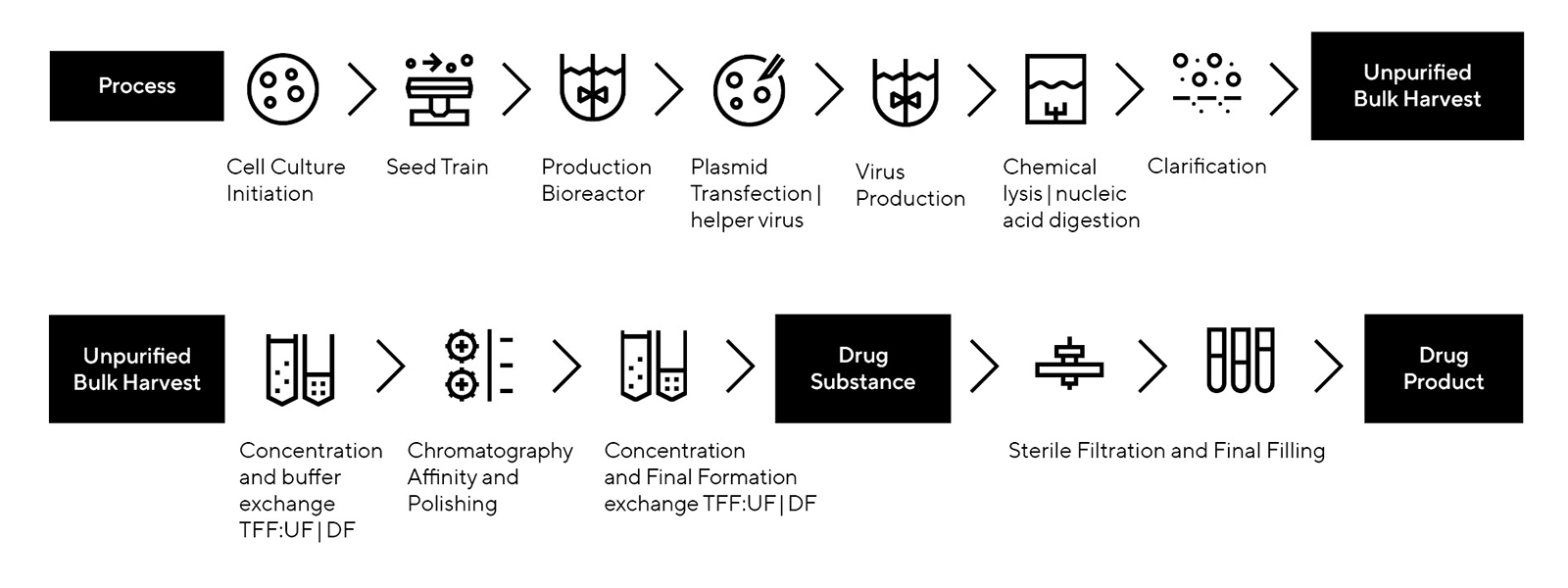
Testing packages can support characterization from starting materials (master virus seed stock and working virus seed stock) to final viral product release (unprocessed bulk harvest, drug substance, and drug product).
Custom work packages can be developed, with methods removed based on risk.
| Biosafety testing | MVSS | WVSS | UBH | DS | DP | Method | ||
|---|---|---|---|---|---|---|---|---|
| Microbiological safety | Sterility and mycoplasma | EP & USP Pyros Kinetix® | ||||||
| Mycobacterium | - | - | - | |||||
| Endotoxin | - | - | - | - | ||||
| Viral safety | Retrovirus: detection and quantification | - | - | - | PERT | |||
| Adventitious agents | In vitro assays | - | - | - | In vitro | |||
| In vivo assays | - | - | - | - | In vivo | |||
| RCA for recombinant adenovirus | - | - | RCA | |||||
| Species-specific viruses: bovine and porcine viruses, human and simian viruses, and SARS-CoV-2 | - | - | - | PCR | ||||
| Identity, potency, and purity testing | MVSS | WVSS | UBH | DS | DP | Method | ||
|---|---|---|---|---|---|---|---|---|
| Identity | Sterility and mycoplasma | - | - | - | - | Sequencing | ||
| Potency | Total particles | - | - | - | - | - | PCR | OD | |
| Infectivity titer | Cell-based | |||||||
| Purity | Process residuals | Bovine serum albumin and host cell DNA | - | - | - | -/Y | Y | ELISA, PCR |
| Benzonase® and total protein | -/Y | -/Y | Micro BCA | |||||
| Others | pH, osmolality, and appearance | - | - | - | Y | Y | Chemistry | |
| Extractable volume | - | Y | Physical | |||||
AAV testing services
Adeno-associated virus (AAV) offers advantages in gene delivery, such as long-term gene expression, non-pathogenicity, and very low immunogenicity. However, AAV manufacturing comes with challenges. Regulatory requirements are complex and evolving, aggregation occurs across serotypes, and products can contain full, empty, and partially filled capsids. AAV is also non-replicating, making process and product characterization extremely challenging.
To support your AAV manufacturing, Sartorius offers AAV testing services from research and development to regulatory approval — with guaranteed testing slots and expertise from our experienced, dedicated team.
Navigate regulatory requirements with ease
- Address evolving AAV regulatory expectations
- Reduce the risk of costly regulatory setbacks
- Co-develop and validate AAV characterization for safety, identity, purity, and potency
- Benefit from proven regulatory support across FDA, EMA | CAT, and agencies in Korea, Japan, and China
Simplify Product Characterization in Early Development
In early development, save time on basic product characterization by outsourcing testing methods. Our selection and expertise enable you to focus on process development, so you can increase final yield and move to the next development stage sooner.
Streamline the Transition From Early Stage to Clinical Trials
When an AAV drug candidate is considered ready for pre-clinical studies, manufacturers need to perform a complete characterization by evaluating product- and process-related impurities.
Support your AAV product’s entry into clinical trials with our broader product characterization, including general product quality and physicochemical aspects. Our testing methods are designed to help you meet regulatory requirements along with generic qualification of assays.
Speed up Late-Stage Development and Commercialization
To enter later clinical trials and navigate commercialization, you need complete product characterization that meets regulatory requirements, as well as testing methods validated for your specific AAV product and phase.
Leverage our pre-qualified testing methods and off-the-shelf assays to make turnaround times fast. If you need product-specific optimization, our team has developed and qualified assays for the most used AAV serotypes.
Testing Methods & Regulatory Guidelines

Lentivirus and CAR-based therapies
Rigorous characterization of lentiviral vectors and CAR-based cell therapies — covering identity, potency, purity, and safety — is critical to support successful IND submissions and regulatory approval.
The complexity of gene-modified cells and integrating vectors demands careful linking of critical quality attributes to clinical performance and safety.
Sartorius offers phase-appropriate analytical services for lentivirus and CAR-T | CAR-NK products, including ready-to-use assays and development, qualification, and validation of dedicated methods to characterize your gene-modified cell therapies.
An example testing package is shown in the table below — supplemented by custom method development.
Lentivirus (LV)
| Biosafety testing | UBH | DS | DP | Method |
|---|---|---|---|---|
| LV replication-competent virus | Cell-based | |||
| Microbiological safety | - | Various | ||
| Viral safety | - | - | Various |
| Identity, potency, and purity testing | UBH | DS | DP | Method |
|---|---|---|---|---|
| P24 capsid titer | - | ELISA | ||
| Gene of interest | - | ddPCR | sequencing | ||
| Genomic titer | - | Custom (ddPCR) | ||
| Viral particle titer | - | ELISA | ||
| Expression of gene of interest | - | Custom | ||
| Biological activity | - | Custom | ||
| Functional | Physical particles | - | Custom | ||
| Residuals: HEK293 host cell proteins, BSA, Benzonase®, plasmid (kanamycin), transfection reagents, and others | - | ELISA, PCR, HPLC, and custom |
CAR-T | CAR-NK
| Testing | UBH | DS | DP | Method |
|---|---|---|---|---|
| Gene of interest | - | Sequencing | ||
| Cellular composition | - | Flow cytometry | ||
| Product-specific residuals | - | Various | ||
| Viability | Custom | |||
| Vector copy number | - | Custom | ||
| Biological activity | - | Custom | ||
| LV replication-competent virus | - | Cell-based | ||
| Microbiological safety | Various | |||
| Viral safety | Various |


Accelerate your development timeline with validated analytical and safety assays from Sartorius, reducing the need for time-consuming assay development.
Our ready-to-use, pre-qualified assays have been extensively tested with a range of molecules. More complex methods can be customized to meet your needs
A dedicated client manager serves as a single point of contact. This manager develops an in-depth knowledge of your work and is positioned to provide concrete, individualized support.
In addition, you have access to the extended Sartorius team of experts, including technical and regulatory teams available to discuss challenges related to your product characterization work.
Manufacturers can rely on the quality of our validated equipment and systems. To support fast, efficient assay transfer to a regulated facility, Sartorius considers future validation needs during early-phase assay development. Sartorius facilities are fully cGMP-compliant and have excellent audit track records with the FDA and EMA | MHRA.

Trusted product characterization expertise
Since 2007, our team has built platform methodologies for the rapid development of critical bioassays. A qualified potency assay is typically needed for lot release in clinical phases and must be fully validated at the commercial stage. Using functional bioassays together with structural and physicochemical analyses early in development supports faster, better decisions and helps avoid delays in costly clinical trials.
Ongoing characterization across clinical and commercial stages enables pool and clone selection, critical quality attribute analysis, and early planning for complex bioassays.