
Octet® BLI Automation and Integration
From discovery through process development to manufacturing, Octet® Biolayer Interferometry (BLI) systems are automation-ready and robot-compatible, integrating seamlessly into a wide array of biologic workflows. As the demand for automation of real-time label-free assays continues to rise, many traditional techniques prove challenging to automate. Our portfolio of proven solutions streamlines the automation process, helping you achieve faster time-to-market and cost savings.
From IgG titer to epitope binning, our BLI platform combines label-free molecular interaction analysis with cutting-edge high-throughput systems. These systems facilitate the rapid characterization and development of biologics drug molecules. Featuring high detection sensitivity, and throughput, along with compatibility with 384-well microplates, Octet® BLI systems will enhance discovery and development with reproducible performance and scalability, offering a simplified pathway to success.
Systems

Octet® RH96
96-Channel Ultra High-Throughput Octet® System
Monitors up to 96 biosensors simultaneously, enabling label-free detection for protein quantitation and kinetic characterization at unmatched speed.
- 96-well quantitation in as little as two minutes
- Simultaneously reads 8, 16, 32, 48, or 96 wells
- Supports 96-well and 384-well microplate format
- Two microplate locations to maximize throughput and improve workflow

Octet® RH16
16-Channel High-Throughput Octet® System
Ideal for high-throughput applications that demand high sensitivity and low sample volume requirements.
- Analyze up to 16 samples simultaneously
- Supports 96-well and 384-well microplate format
- Two microplate locations to maximize throughput and improve workflow
Features and Benefits
Octet® BLI automation will improve sample throughput, reduce operator time, and streamline data audit trails.
- Software API available for external function calls
- Compatible with ANSI/SLAS standard labware
- Chamfered loading nests
- Spacing for robotic fingers to grip the sides of the plate
- Small footprint
- Very robust
- GxP packages with 21 CFR Part 11 software
- Increase throughput
- Increase walkaway time
- Reduce human errors
- Offer environmental control
- Improve space utilization
- Improve worker safety
- Easy to use
Example Solutions
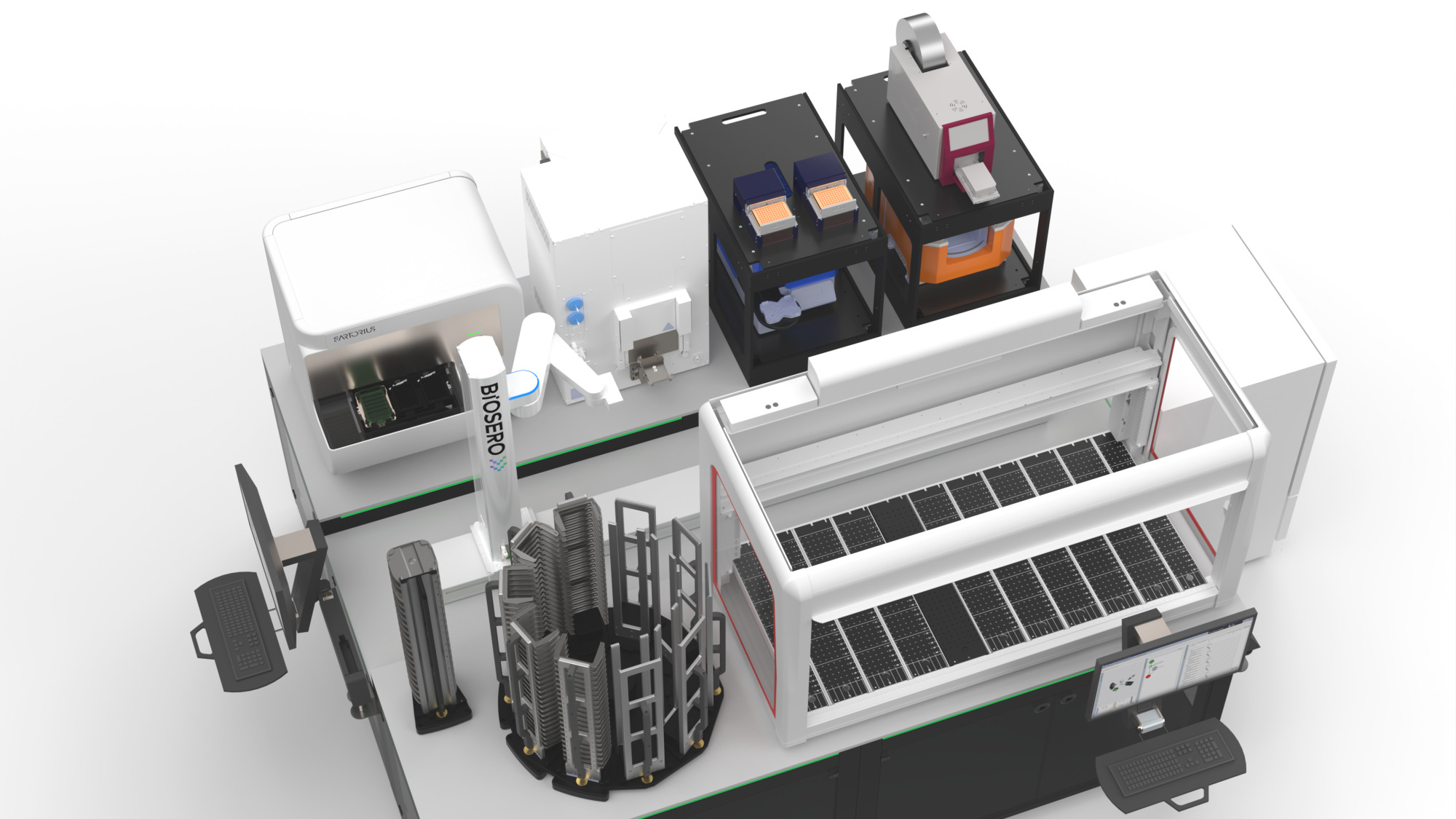
Small Workcell
Begin automating a portion of your workflow by integrating the Octet® system with Biosero.
- Samples are queued on static storage hotels and wait to be loaded onto the Octet® RH96
- A robotic arm with an integrated barcode reader automates sample loading
- Green Button Go easily allows users to select which sample plates run automatically
Optional: Add an external incubator for additional environmental storage
Medium Workcell
Increase throughput with parallel processes and additional automated steps.
- Double your throughput with two Octet® RH96 systems
- Centrifugate plates and seal for medium-term ambient storage
- Use larger ambient plate storage to hold sample plates and biosensor trays
Large Workcell
Build end-to-end automated workflows to custom specifications to achieve unique research goals.
- Automate various plate preparation protocols and free up valuable space on the liquid handling deck to get more use out of your liquid handler (LH)
Featured Applications

Cell Line Development
Biology waits for no one. If cells need refeeding at 3 a.m. or imaging over the weekend, scientists must go to the lab and tend to them. With automation, however, the workcell can automatically schedule runs and record data, even making data-driven decisions as the cells grow.
This example cell line development system uses a liquid handler for refeeding, transfection, and all other liquid handling needs. An automated Incubator stores all reagents and cell plates, while an automated screw capper caps and recaps tube racks. Finally, the imaging cytometer is utilized for sample confluence reads.
In this example, single cells are plated from a single cell dispenser, they are re-fed and grown, imaged at defined time points, and then transfected once a certain confluency level is reached. This solution enables scientists to automate longer portions of their workflow minimizing manual touchpoints that slow down the work or require extreme working hours.
Partners
Octet® BLI Automation Powered by Green Button Go

Biosero® is the preferred automation partner for the Octet® BLI platform, accelerating real-time, label-free assays to support bioprocess and drug discovery workflows. Octet® systems seamlessly integrate with Biosero’s Green Button Go® software to participate into end-to-end automated workflows with multiple devices from different manufacturers.

Biosero® designs and builds integrated laboratory automation solutions through Green Button Go for top labs around the world.
Once deployed in Green Button Go®, Octet® systems can be scheduled to run alongside other required automation tools to deliver results at any time of day.
Green Button Go’s operator friendliness, flexibility, and best-in-class error handling help to keep automation solutions running longer with less downtime.
Automated workcell images provided by Biosero.

Request a Quote, Demo, or More Information
Octet® Automation FAQs
Overview and Value
Octet® Automation integrates Octet® biolayer interferometry (BLI) instruments with robotic liquid handlers and scheduling software to run label free quantitation and kinetics assays at high throughput with minimal manual intervention.
Automation increases throughput, consistency, and reproducibility; reduces hands-on time and human error; enables unattended runs; and standardizes titer and kinetics across discovery, process development, and QC.
IgG/protein titer, kinetics (kon/koff/affinity), epitope binning, stability screening, ligand binding, small molecule interactions, and protein quantitation from crude samples using compatible Octet® BLI biosensors.
Compatibility and Integration
Octet® BLI systems, such as the Octet® RH16 or the Octet® RH96, integrate with leading platforms from vendors such as Biosero, Hamilton, Tecan, Hudson Robotics, Thermo Fisher, and most others via standard I/O, drivers, and scripting. Speak with Sartorius for validated configurations.
Common industry-standard lab scheduling tools (e.g., device schedulers used with major robotics vendors) can control plate movements, biosensor loading, incubation timing, and assay sequences via Octet® automation interfaces or drivers.
Octet® RH16 and Octet®RH96 BLI systems support automated workflows. Sartorius provides integration kits, drivers, and guidance depending on instrument configuration and channel count. Contact us for your exact setup.
Yes. Data export (CSV, Excel, PDF, proprietary formats) fits typical LIMS/ELN pipelines. Custom scripts or APIs can be used to push metadata, results, and QC flags into your data systems.
Performance and Throughput
Throughput depends on instrument channel count, assay type, association/dissociation times, and plate format. Typical automated titer runs complete in minutes per plate; kinetics vary from rapid screens to longer affinity determinations.
Robots can queue biosensor racks and multiple 96 or 384 well plates for continuous, overnight, or multiday operations.
Octet® BLI assays typically use 96- or 384-well plates that require 200 µL or 60 µL per well, respectively, for automated runs.
Assay Design and Biosensors
A broad portfolio covers Protein A/G/L, anti-species, streptavidin, Ni NTA, SAX, and specialized chemistries for small molecules. Choose based on ligand/analyte class and assay objective.
Yes. BLI’s fluidics free design is tolerant of crude samples (e.g., cell culture supernatants) with appropriate assay buffers and controls.
Optimize buffer composition (detergents, salts, blockers), include reference wells, employ regeneration steps where applicable, and use appropriate biosensor chemistries.
Yes. Automated plate handling and programmed sensor loading streamline binning matrices (pairwise or high order), improving repeatability and speed.
Data, Software, and IT
Results can be exported to CSV, XLSX, and PDF; raw and processed data are available for downstream analysis and LIMS ingestion.
Sartorius provides integration options (drivers/interfaces) used by robotics vendors and custom scripting. Contact us for your instrument’s available interfaces and examples.
Octet® software maintains assay metadata, method parameters, and result files. For regulated environments, procedures and controls can support audit and versioning needs.
Setup and Environment
Stable bench space, environmental control within instrument specifications, vibration mitigation, and robot deck compatibility. Electrical, network, and safety interlocks must meet site standards.
Depending on site readiness and complexity, integration may range from days to a few weeks, including driver configuration, method transfer, and user training.
Standard SBS format microplates (96/384) with appropriate well volumes. Confirm plate materials and height tolerances with your robot and instrument.
Operations and Maintenance
Robots can load, track, and dispose or regenerate biosensors per method. Use trays/racks validated for position accuracy and sensor identity.
Regular instrument checks, sensor calibration/verification, plate position alignment, and robot gripper calibration. Follow preventive maintenance schedules for both instrument and robot.
Scheduling software can pause, resume, or reroute tasks. Octet® methods can be designed with fail safes, reference checks, and recovery steps to protect data integrity.
Use Cases and Benefits
Antibody discovery and optimization, process development, cell line screening, upstream/downstream analytics, formulation stability studies, and QC titer testing.
BLI’s fluidics free design reduces clogging risk and maintenance, supports rapid plate-based workflows, and is well suited for high throughput screening and quantitation.
Yes. Start with semi-automated steps (plate prep, sensor loading) and expand to fully unattended scheduling as methods mature.
Cost and ROI
Reduced labor costs, faster decision cycles, higher data quality, and increased instrument utilization. Many users achieve significant savings in high throughput titer and screening workflows.
Integration consultation, method transfer assistance, operator training, IQ/OQ/validation guidance, and ongoing technical support.