Automated Imaging, Single Cell and Colony Picking, to Simplify Cell Line Development Challenges
The new CellCelector CLD is an automated cell imaging and isolation platform built to streamline cell line development (CLD). Assess productivity faster, reduce scanning times, and simplify operations with a maintenance-free design. With advanced sensitivity for low-expression targets and a new shading correction algorithm, you get clear, reliable imaging to rapidly identify and document your best clones.
Why CellCelector CLD:
- Accelerate productivity assessment with high-speed scanning and intelligent imaging
- Detect low-expression target molecules with advanced sensitivity
- Improve image consistency using a new shading correction algorithm
- Reduce downtime thanks to maintenance-free operation
- Rapidly identify and document top clones from large candidate pools
- Achieve up to 100% transfer efficiency and viability for confident downstream expansion
Explore the CellCelector CLD
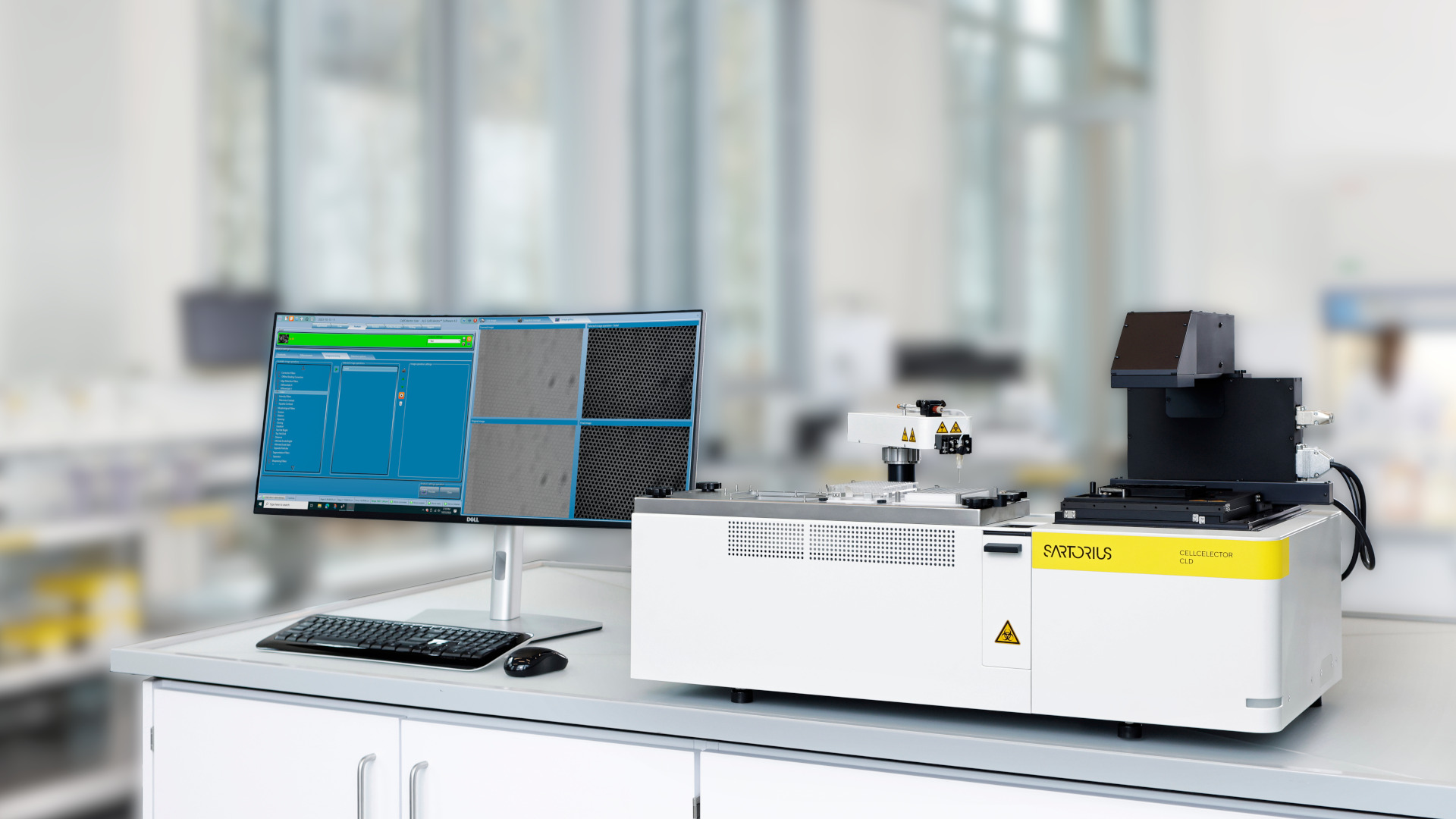


Performance you can trust:
- Faster scanning for higher throughput without sacrificing image quality
- Up to 100% transfer efficiency and viability to protect precious clones
- Optimized reagents that support robust outgrowth
- Next generation Nanowell plates designed to increase clone outgrowth and productivity
- Seamless alignment with Sartorius’ CHO cell line portfolio and specialized media for high-yield, stable recombinant protein production
CellCelector CLD Features
Can I streamline and de-risk monoclonal cell line development (CLD) for biologics using next generation single cell cloning, automated imaging based monoclonality verification, high throughput fluorescence productivity screening, and gentle viable clone isolation with end to end audit ready data capture?
How it works:
- Seed candidate pools using Next Generation CLD Nanowell Plates to maximize single cell occupancy and minimize cross contamination across thousands of microenvironments.
- Screen for single cell nanowells with automated brightfield imaging and segmentation to confirm single cell occupancy and exclude multicell wells.
- Assess monoclonal growth using high sensitivity imaging to track lineage and clonal expansion across timepoints, providing visual proof of monoclonality.
- Analyze clone productivity using fluorescence (optional) to quantify secretion/binding, stability, or other markers; enable multiplex assays for rapid, high throughput ranking.
- Isolate and transfer top clones with viability preserving, gentle retrieval to culture vessels; under optimized conditions, achieve up to 100% viability.
- Document images and metadata automatically with custom reporting templates—plate maps, timestamps, analysis masks, and decision criteria—creating a clear, audit ready record that supports regulatory expectations for clonality evidence.

Key Advantages of the CellCelector CLD


Automated scanning and detection of monoclonal wells
See example data below
High resolution, image-based documentation of monoclonal wells
See example data below
Simultaneous productivity assessment
See example data below
Rapid identification of top clones from hundreds of thousands of potential candidates
See example data below
Up to 100% transfer efficiency and viability
Automated documentation of transferred cells and clones
Example Data for CellCelector CLD

Built for scientists:
- Bioprocess and CLD teams scaling antibody and recombinant protein production
- Labs prioritizing speed, throughput, reproducibility, and clear documentation
- Programs working with low-expression targets that demand higher sensitivity
Request a quote or demo to see the CellCelector CLD in action and discover how it can transform your research.

Boost monoclonality and productivity—screen up to 85,000 clones per plate.
CellCelector Next Generation CLD Nanowell plates enable the high - throughput screening, identification and transfer of up to 85,000 candidate clones from a single plate. Achieve up to 40% more monoclonal wells, over 3x higher clone outgrowth, and fewer conflict wells.
CellCelector Next Generation Nanowell Plates:
- Significantly increase the number of available wells within a plate
- Higher walls decrease the number of conflict wells observed during a scan
- Demonstrate significantly higher clone outgrowth across a range of different cell types

Regulator-ready productivity screening
The CellCelector Productivity Kit pairs optimized protein A capture beads with a matched secondary antibody to deliver consistent, regulator ready results. Purpose built workflows enable seamless addition to actively growing clones with minimal cellular disturbance, preserving cell health and growth kinetics. Specifically designed clone ranking protocols exhibit high correlation to upstream titer measurements, ensuring criterion related validity from early screens through scale up decisions.
To accelerate confident selection, the example shows Day 4 CHO K1 productivity assay outputs highlighting false color images (left), brightfield (middle), and greyscale fluorescent signals (right), enabling clear visual discrimination of high producers at a glance.

CellCelector CHO Media Formulations
Sartorius’ CHO media portfolio is developed for the cultivation of Chinese Hamster Ovary (CHO) and other mammalian cell lines, supporting both stable and transient recombinant protein expression. It comprises multiple media formulations and companion feeds tailored to the most common CHO cell lines across batch, feed-batch, and perfusion processes. Because each CHO variant—and even each subclone—has distinct metabolic requirements, selecting the right media and feed is essential to maximize performance and sustain productivity. To streamline selection, a decision tree guides CHO media screening by leveraging two pre-selected media–feed combinations, helping accelerate confident, data-driven choices.
CellCelector CLD Resources


Educational Resources


CellCelector CLD FAQ
Frequently Asked Questions for CellCelector CLD
The CellCelector CLD is an automated cell imaging and isolation platform designed for cell line development teams. It combines high-sensitivity imaging with automated single-cell and colony picking to streamline screening, selection, and documentation of top clones.
Faster scanning and intelligent imaging reduce screening time. Automated single-cell and colony picking, along with up to 100% transfer efficiency and viability, help you move rapidly from candidate pools to expansion.
Yes. The CellCelector CLD offers advanced sensitivity for low-expression targets and includes a new shading correction algorithm to improve image clarity and consistency.
The CellCelector CLD platform enables clear imaging-based documentation of seeding, growth, and isolation steps, helping you record and monitor the basis for clone selection. Automated scanning of the wells, followed by an automated identification of all wells containing a single cell, provides a robust and documented image-based monoclonality record.
Automated single-cell and colony picking with high precision, achieving up to 100% transfer efficiency and viability to protect valuable clones during transfer. Optimized instrument fluidics facilitate maintenance-free picking and a significantly increased picking efficiency through enhanced capillary sealing.
Yes. The CellCelector CLD is designed for maintenance-free day-to-day operation, minimizing downtime and simplifying routine use.
Antibody and recombinant protein programs that require rapid screening, robust documentation, and sensitivity to low-expression clones benefit greatly from the platform.
The Next Generation CLD Nanowell Plates allow screening of up to 85,000 candidate clones on a single plate, accelerating early cell line development.
Compared to standard plates, the Next Generation CLD Nanowell Plates deliver approximately 40% more monoclonal wells and fewer conflict (multi-cell) wells, supporting clearer monoclonality verification.
Next Generation CLD Nanowell Plates provide over 3× higher clone outgrowth; by Day 4, a larger share of wells meets picking criteria—HEK 293 showed up to 42.3% ready-to-pick wells in comparative tests.
Demonstrated performance gains have been shown with CHO K1 and HEK 293 cells, and the plates are designed to support a range of common mammalian cell lines.
Higher monoclonality rates, consistent surface chemistry, and traceable imaging/audit trails help support regulatory assurance.
Expect more monoclonal wells, significantly faster outgrowth, and fewer disqualified conflict wells—translating into higher hit rates and shorter end-to-end CLD timelines.
The central localizing well makes for easier calibration of the Next Generation CLD Nanowell Plates, in comparison to the older Nanowell plates.
Sartorius provides specialized CHO media formulations tailored to the distinct metabolic requirements of different CHO variants. Used alongside CellCelector CLD’s high-sensitivity imaging and precise single-cell/colony picking, these media support robust clone outgrowth and consistent performance—helping you identify top clones faster and enabling high-yield, stable recombinant protein production from selection through scale-up.
Request a demo or speak with a Sartorius expert to discuss integration of the CellCelector CLD into your workflow. Detailed product specifications and ordering information are available too.